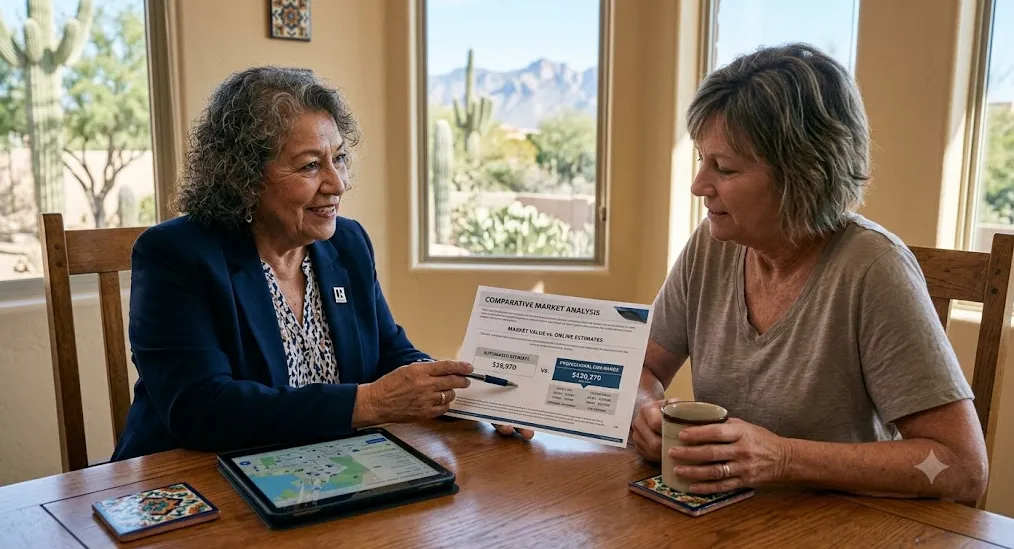
Can You Trust Online Home Value Estimates?
Understanding What Automated Home Values Can—and Cannot—Tell You
By Martha Viera Parsons
Associate Broker | REALTOR®
HomeSmart Advantage Group
It's One of the First Things Most Homeowners Do
If you've ever been curious about what your home might be worth, you've probably typed your
address into one of the popular real estate websites.
Within seconds, an estimated value appears on your screen.
It's fast.
It's convenient.
And it naturally leads to another question:
"Is this really what my home is worth?"
The answer is that online home value estimates can be a helpful starting point—but they should not
be viewed as a final opinion of value.
Understanding how these estimates work can help you use them wisely.
How Online Estimates Are Created
Most online valuation tools use automated computer models that analyze publicly available
information.
They may consider factors such as:
The property's size
Lot size
Number of bedrooms and bathrooms
Year built
Previous sales history
Public tax records
Recent sales of nearby homes
Using this information, the computer generates an estimated value.
These systems can process thousands of homes quickly, but they don't actually visit your property.
What the Computer Cannot See
This is where online estimates have limitations.
A computer cannot walk through your front door.
It doesn't know if you've remodeled your kitchen.
It can't see your updated primary bathroom.
It doesn't know whether you've installed a new roof, replaced the HVAC system, upgraded your
windows, or invested in professional landscaping.
Likewise, it cannot recognize deferred maintenance, unusual floor plans, or features that may affect
buyer interest.
Those details often matter when evaluating a home's market position.
Location Is More Than an Address
Two homes may have similar square footage and be located close to one another, yet appeal to
different buyers.
Perhaps one home backs to a golf course.
Another enjoys panoramic mountain views.
One sits on a quiet cul-de-sac.
Another is closer to a busy roadway.
Even within the same community, those differences may influence buyer demand.
An automated valuation model may not fully account for these characteristics.
Real Estate Is Local
One of the most important lessons I've learned during my real estate career is that every market has
its own personality.
National headlines rarely tell the complete story of what's happening in a specific neighborhood.
Southern Arizona is no exception.
Buyer preferences can vary from one community to another.
Some buyers prioritize active adult amenities.
Others focus on mountain views, larger lots, or proximity to shopping and healthcare.
Market activity can also differ between neighborhoods that are only a few miles apart.
That's why local knowledge remains an important part of understanding today's market.
Comparable Sales Tell a Bigger Story
When REALTORS® prepare a Comparative Market Analysis, often called a CMA, we look beyond
computer-generated estimates.
We study recently sold homes that are similar in size, age, condition, location, and features.
We also consider current homes competing for buyers' attention and recently pending sales that may
reflect current market activity.
No two homes are exactly alike.
The goal is not to find identical properties but to understand how buyers are responding to similar
homes in today's market.
Improvements Matter
Many homeowners invest in their property over the years.
You may have remodeled the kitchen.
Updated bathrooms.
Added energy-efficient windows.
Installed new flooring.
Improved the landscaping.
Expanded the patio.
Replaced major systems.
Some improvements may influence buyer appeal, while others may simply improve your enjoyment of
the home.
Either way, those updates are difficult for an automated system to fully evaluate.
That's one reason online estimates and professional market analyses sometimes produce different
results.
Market Value Is Ultimately Determined by Buyers
One important point is worth remembering:
No website, REALTOR®, appraiser, or computer determines market value by themselves.
Market value is influenced by what informed buyers are willing to pay for a property under current
market conditions.
The role of a Comparative Market Analysis is to provide information that helps estimate where a
home may be positioned in today's market.
It's one valuable tool that can help homeowners make informed decisions.
When Should You Request a Comparative Market Analysis?
A CMA can be especially helpful if you're:
Thinking about selling in the next year.
Curious about your home's current market position.
Considering downsizing.
Planning a move to another community.
Helping a family member prepare for a future sale.
Even if you're not ready to sell today, understanding your home's market position can help with future
planning.
Final Thoughts
Online home value estimates are convenient and can provide a useful starting point.
However, they don't replace local market knowledge, professional analysis, or an understanding of
the unique features that make every home different.
If you're curious about your home's current market position in Southern Arizona, I'd be happy to
prepare a personalized Comparative Market Analysis and answer your questions.
My goal is never to pressure you into selling.
It's simply to provide the information you need so you can make confident decisions whenever the
time is right for you.
About Martha Viera Parsons
Martha Viera Parsons is an Associate Broker with HomeSmart Advantage Group and founder of MVP
Realty Team. With nearly 50 years of real estate experience, she helps buyers and sellers throughout
Southern Arizona make informed real estate decisions through education, personalized guidance,
and exceptional communication. Her approach is centered on helping clients understand their options
so they can move forward with confidence.
MVP Realty Team
HomeSmart Advantage Group
